CEIS101 / COMPLETED ACADEMIC PROJECT
Smart Home Automation & Security Prototype
Connecting physical inputs to useful behavior.
A hands-on Arduino project exploring door state, distance sensing, light detection, and simple automated responses.
DeVry University coursework01 / THE OBJECTIVE
Smart Home Automation & Security Prototype
A small automation system must translate changes in the physical environment into understandable feedback. The project built that connection incrementally through sensors, indicators, and code.
02 / THE WORK
My contribution.
- Used Tinkercad to explore a circuit prototype before documenting the hardware build.
- Assembled a breadboard circuit and programmed the system through the Arduino IDE.
- Added door-state and ultrasonic-distance sensing with LED feedback and serial-monitor output.
- Added light-responsive behavior and documented observations in a distance-data chart.
Door · Distance · Ambient light
Arduino logic
LED indicators · Serial output
03 / PROJECT EVIDENCE
What the work produced.
A completed prototype presentation with original hardware photographs, circuit views, Arduino code screenshots, and sensor-output evidence.
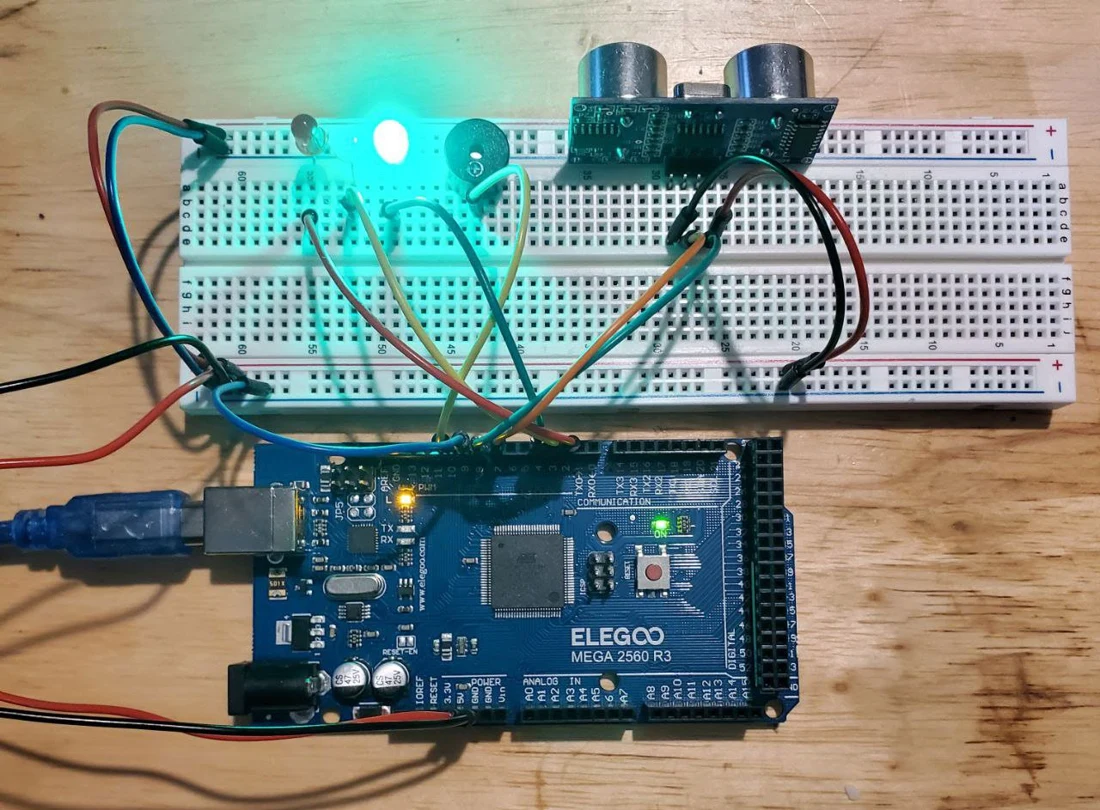
Evidence reviewed: CEIS101 final project presentation. Source pages 4–5, 8–10, 12–26.
04 / WHAT I LEARNED
The reasoning behind the result.
Incremental builds make hardware debugging easier: check the wiring, confirm the input in the serial monitor, and then add the response logic.
05 / WHAT THIS DEMONSTRATES
Practical skills in context.
Connecting hardware inputs, program logic, and observable behavior.
Project deliverable: An incremental sensor-and-indicator prototype, documented with hardware photos and code.
Status & scope
Completed tabletop prototype for educational use. Original hardware photographs document the coursework; product certification and home deployment are outside its scope.
Based on the original project presentation, reviewed October 17, 2026. Historical project evidence; not a new execution test.